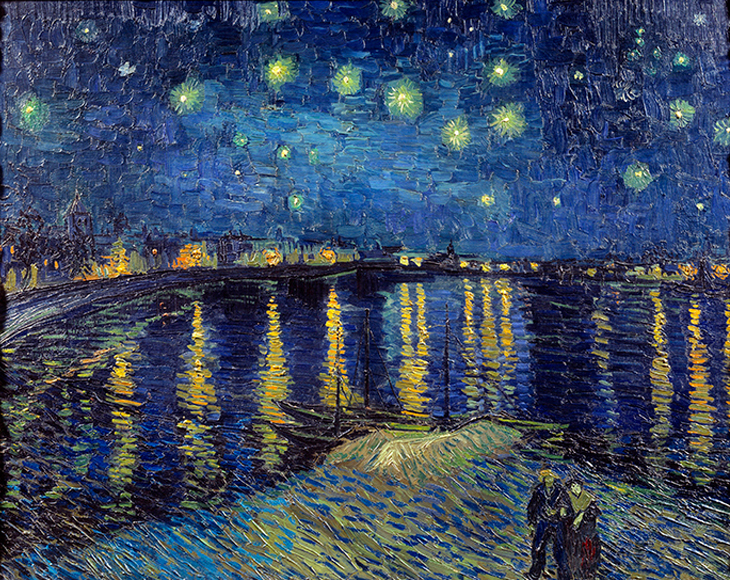
Oil on canvas, 73 x 92 cm
Musée d’Orsay Paris, France
Vincent van Gogh also seemed to seek solace in his nocturnal paintings. The peaceful mood and the use of color suggest this.
The constellation ‘Big Dipper’ is clearly visible in the middle of the sky. Van Gogh colored the stars: “[…] you will see that some stars are lemony, others have pink, green, blue, […] it is obvious that to paint a starry sky it is not enough to put white dots […] on blue-black.“
The reflections on the water could also come from the first electric street lamps. This would make Van Gogh one of the first painters to capture electric light on canvas.
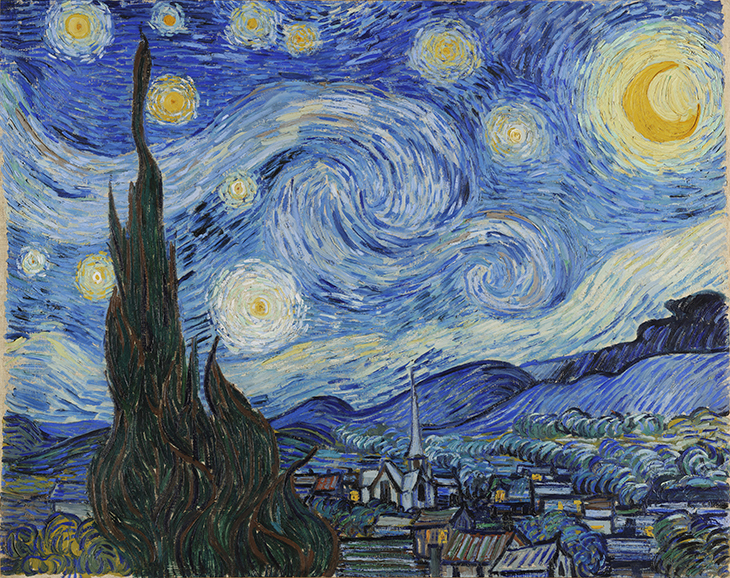
Oil on canvas, 74 x 92 cm
Museum of Modern Art New York, United States
Vincent van Gogh painted this famous work when he was in the mental hospital in Saint-Rémy. As in many of Van Gogh’s paintings, the positions of the stars are depicted realistically. Whether Van Gogh really saw the vortex in the middle, or whether it is a symbol of his emotional state, will forever remain his secret.
The perspective of the painting transports the viewer to a window on the second floor of the sanatorium. As Van Gogh was only allowed to paint there under supervision, experts today consider it likely that it was painted from memory in the studio.