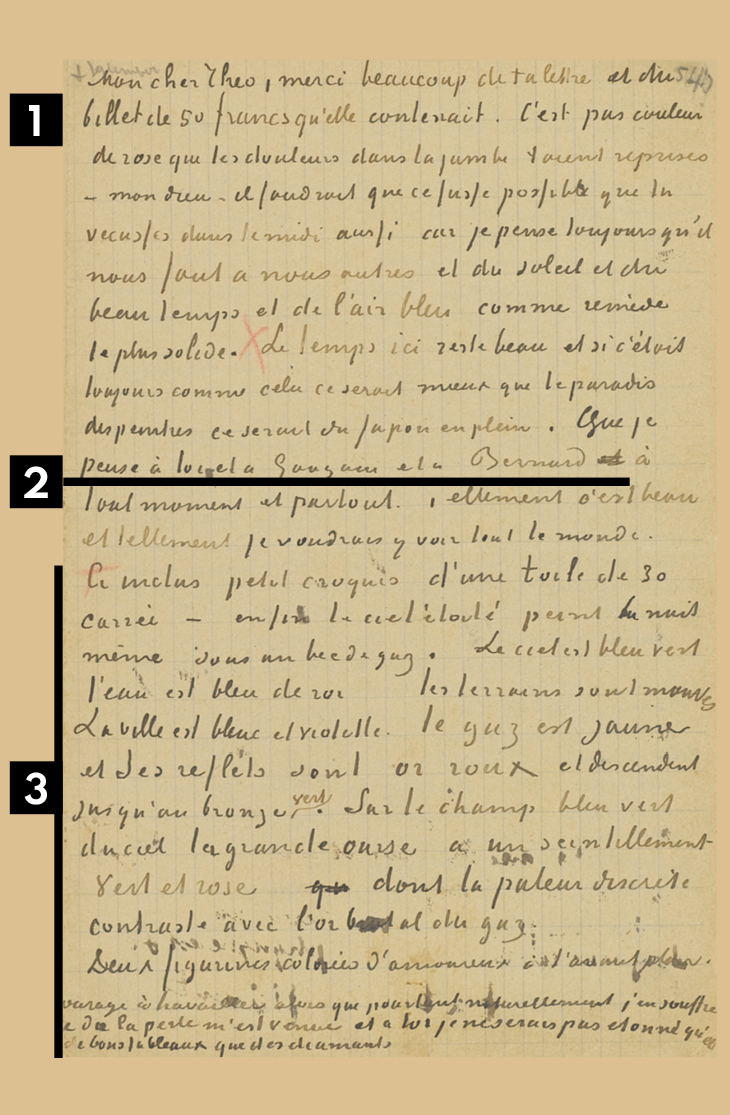
1 | A Typical Beginning
Vincent often initially thanked his brother for his support.
“My dear Theo,
thank you for your letter and the 50-franc note in it. It doesn’t look rosy if the pain in your leg has returned – my God – it should be possible for you to live in the south too, because I constantly think that we need sun and beautiful weather and blue air as the most reliable remedy.“
2 | The Longing for Friends
Vincent felt anticipation for his artists’ colony in the south.
“How much I think of you and Gauguin and Bernard, every moment and everywhere. It’s so beautiful and I wish so much to see everyone here.“
3 | Discussion About Art
Here Vincent described in detail his painting ‘Starry Night Over the Rhône’ and included a sketch.
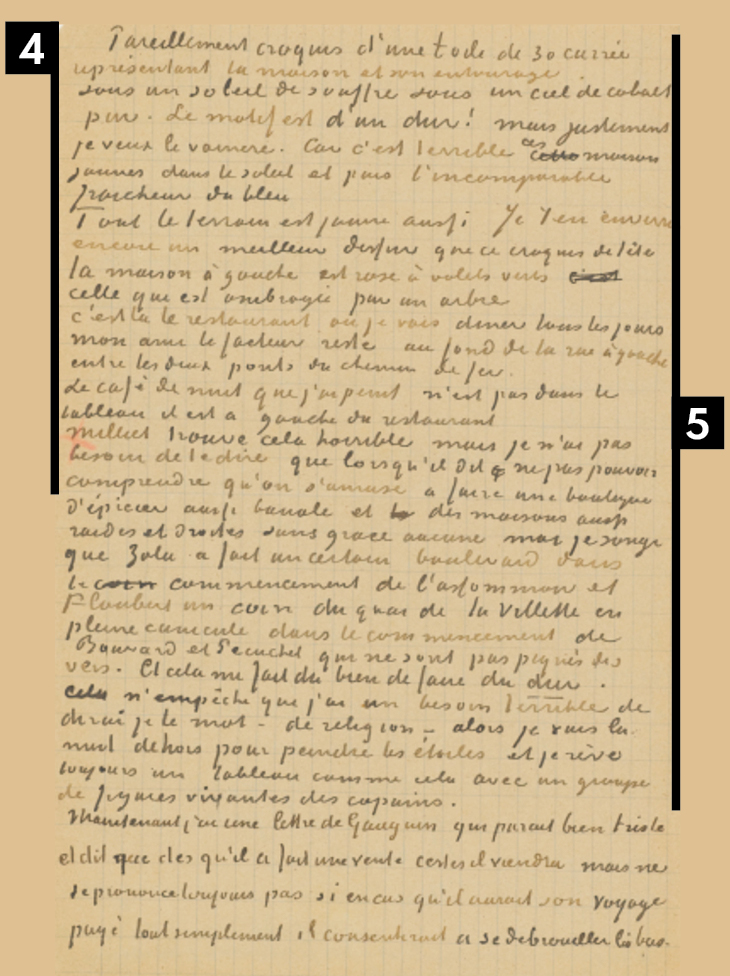
4 | This was followed by another description with a sketch of the painting ‘The Yellow House’.
5 | Work and Religion
Vincent also seemed to escape into painting. The theme of religion never left him and was probably also the motivation for the painting ‘Starry Night Over the Rhône’.
“And it does me good to do something difficult. That doesn’t change the fact that I have a terrible need for, shall I say the word? – for religion – so I go out at night to paint the stars, and constantly dream of such a picture with a group of living figures, of friends.“
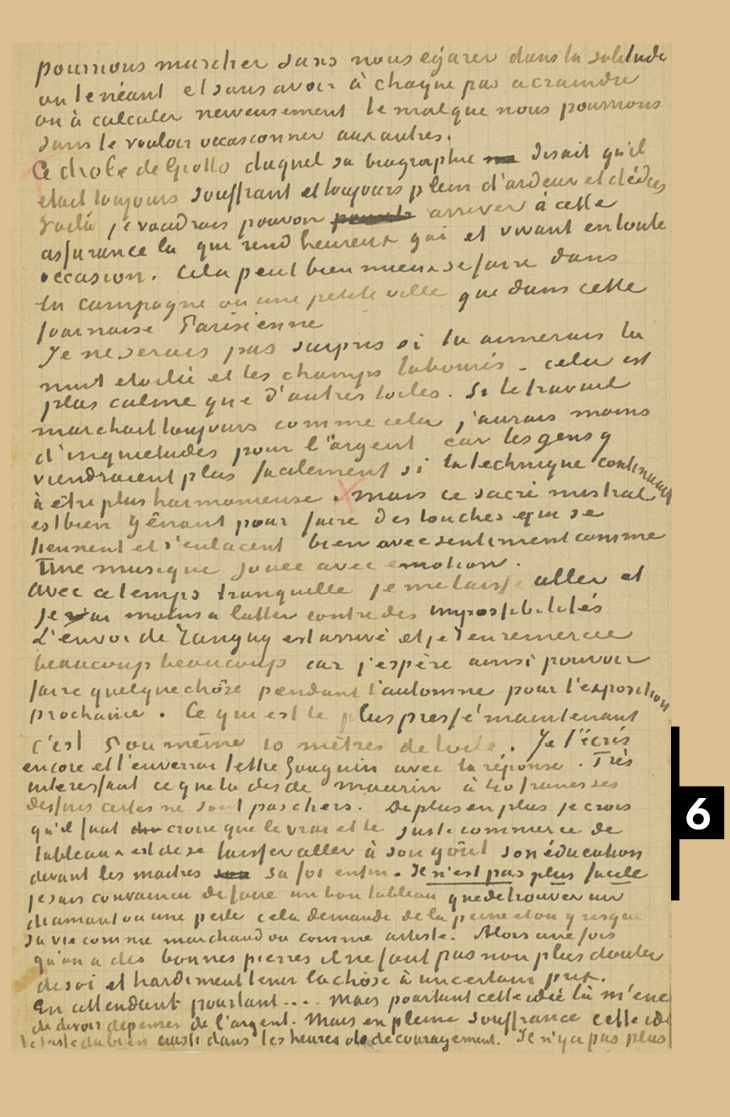
6 | Trusting One’s Own Taste
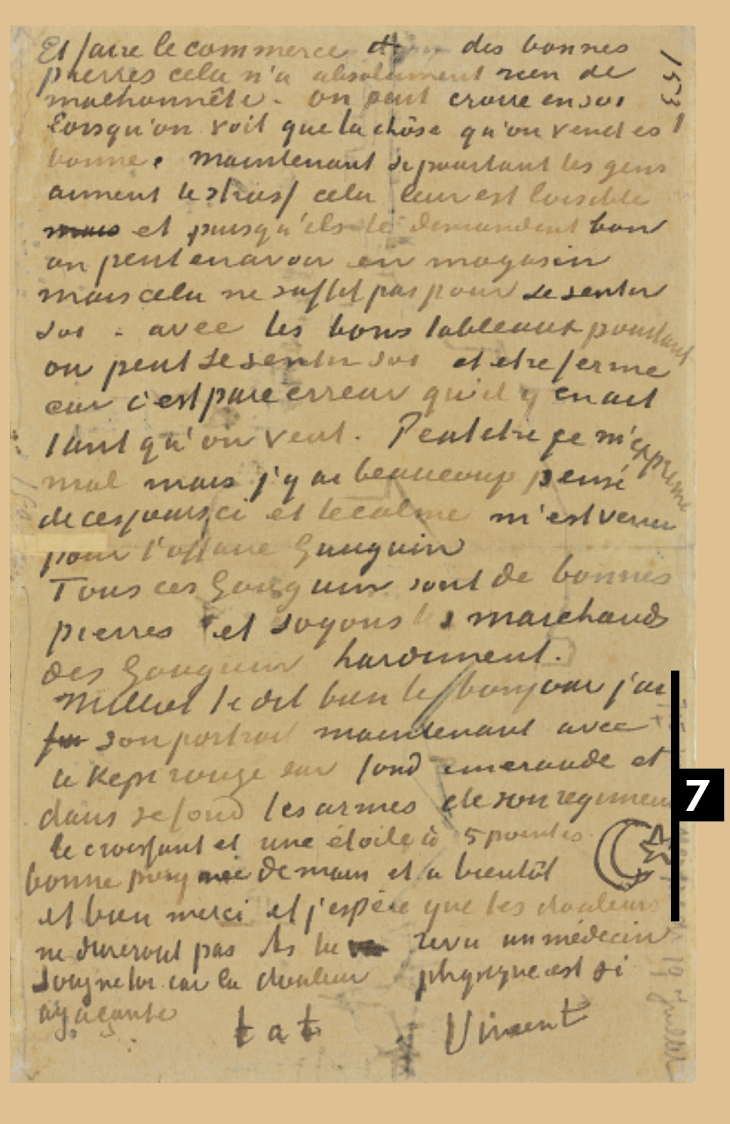
Painting according to one’s own conviction or for sale? A question every painter must face. Van Gogh’s answer to this shows how seriously he took painting.
“More and more I believe that we must believe that the true and correct picture trade consists in trusting one’s own taste, the education gained before the masters, in a word, one’s own faith. It is not easier, I am convinced, to make a good picture than to find a diamond or a pearl, it requires effort, and one risks one’s life in the process, as a dealer as well as an artist.“
7 | Picture Exchange
Here Van Gogh speaks about his friend Paul-Eugène Milliet – a lieutenant whom he admired for his amorous escapades (hence his portrait is now called ‘The Lover’).
“Milliet sends you his warm regards, I now have his portrait with the red cap on an emerald green background, and in this background the signs of his regiment, the crescent moon and a star with 5 points.“
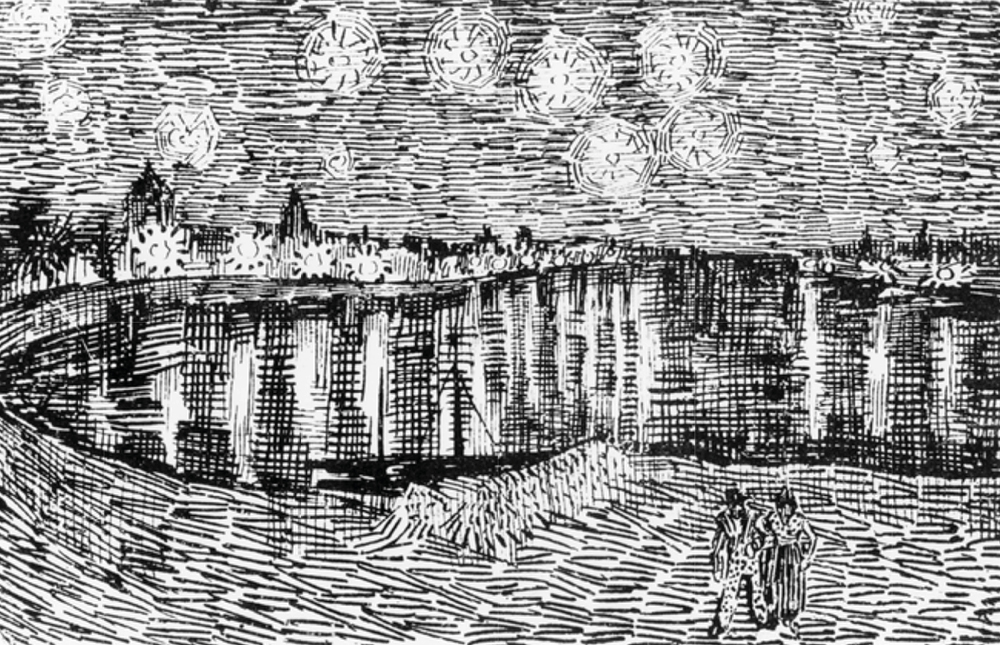
“Enclosed is the small sketch of a square canvas No. 30 – finally the starry sky, painted at night, by gaslight. The sky is blue-green, the water is royal blue, the fields are pale purple. The town is blue and violet. The gaslight is yellow, and its reflections are red-gold and descending to bronze-green. On the blue-green field of the sky, the Great Bear has a green and pink glow, whose subtle paleness contrasts with the raw gold of the gaslight. Two colored figures of lovers in the foreground.“
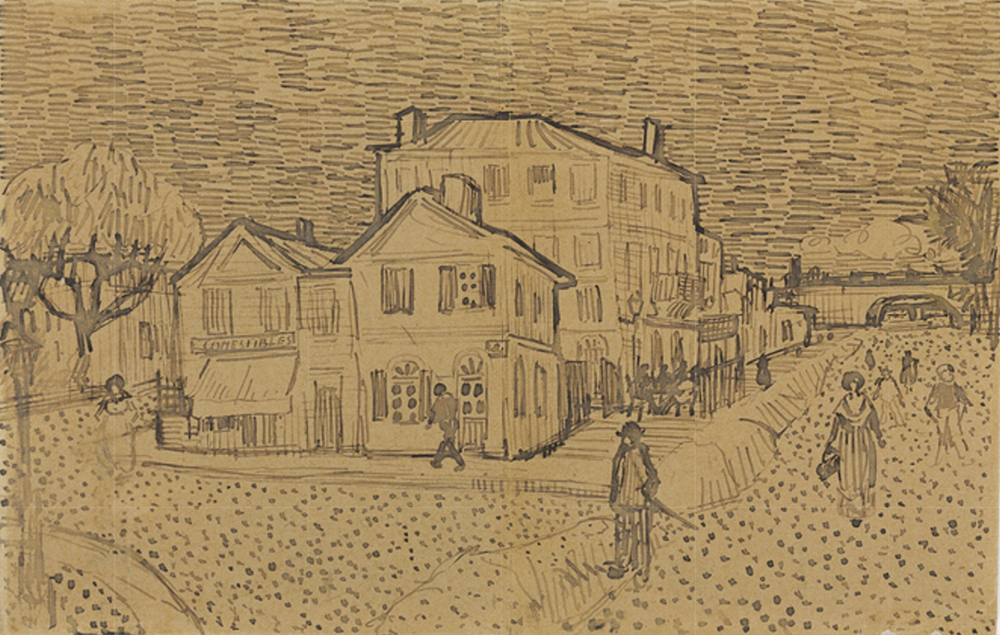
“Likewise, the sketch of a square canvas No. 30, showing the house and its surroundings under a sulfur-yellow sun, beneath a sky of pure cobalt. This is truly a difficult subject! But I want to conquer it for this very reason. For it is terrible, these yellow houses under the sun, and then the incomparable freshness of the blue.
The entire ground is also yellow. I will send you another drawing that is better than this sketch from memory; the house on the left is pink, with green shutters; the one in the shade of the tree is the restaurant where I have dinner every day. My friend, the postmaster, lives at the end of the street on the left, between the two railway bridges.“